

18,270 BTC Left Binance With Valid Signatures. Who Signs Yours?
18,270 BTC left Binance in one block, every transaction validly signed. What happened, why it matters, and how a Keystody vault is built for it.
1. What happened at Binance
- When. Thursday 29 October 2026, most of it in about twenty minutes from 20:05 UTC.
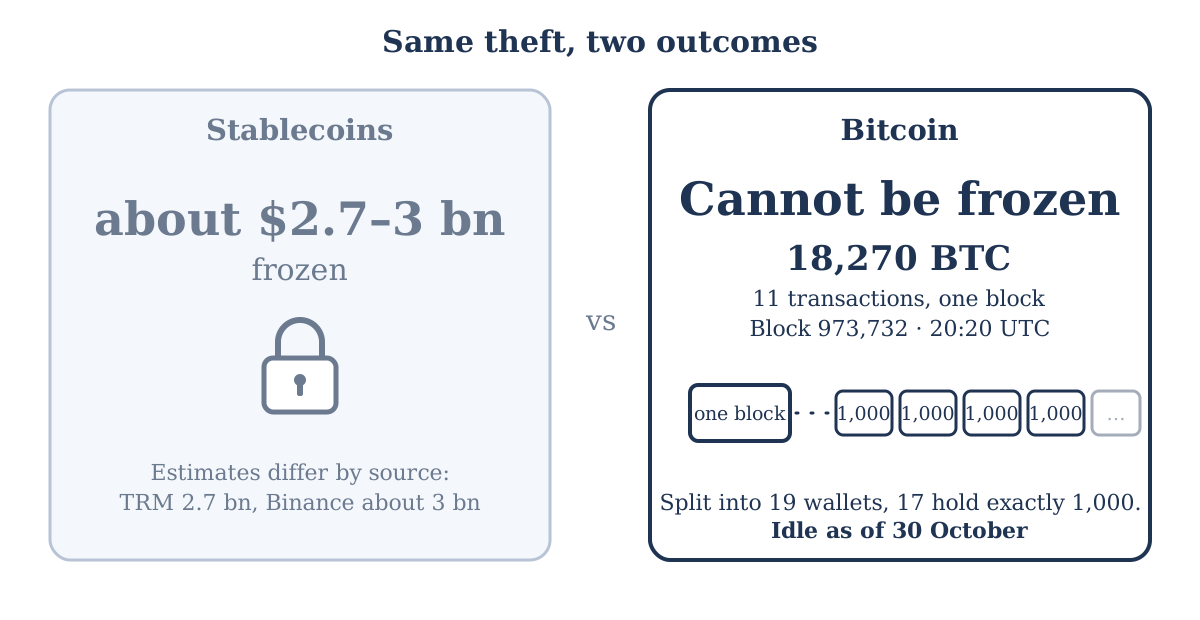
- The Bitcoin. 18,270 BTC left one Binance hot wallet in eleven transactions, all confirmed in a single block, 973,732, at 20:20 UTC.
- What got frozen. About $2.7 to 3 billion of stablecoins taken in the same attack. Of the Bitcoin, none. It cannot be frozen, and it has since been split into round 1,000 BTC pieces.
- The total. About $6.36 billion across ten networks, by TRM Labs' count.
- Who. TRM Labs and Chainalysis attribute the attack, with high confidence, to TraderTraitor, a unit within North Korea's Lazarus Group. Binance has not named anyone.
Then the part that matters. Binance says it has "found no evidence of any wallet private key" leak. Yet every one of those transactions carried a valid signature from a Binance-controlled wallet. In TRM Labs' reading, this "points to a compromise of Binance's hot wallet signing infrastructure." Binance's first finding pointed to what "may involve a compromised DevOps engineer's laptop," and it has since found "additional points of breach."
The thing that signs was made to sign.
2. Why this one matters
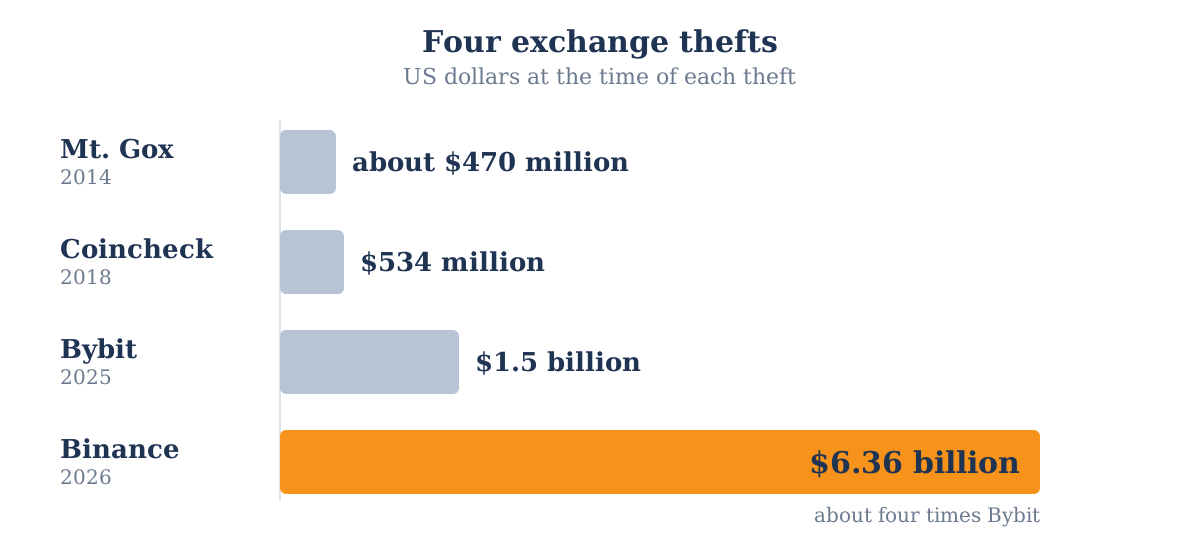
- The scale. By TRM Labs' count it is about four times the previous record, Bybit in February 2025 at about $1.5 billion. Elliptic's chief scientist called it "almost certainly the single largest known theft of any kind."
- The exchange signs. You never do. On an exchange, your Bitcoin is a row in their database. When it moves, their systems sign, and there is no step at which you see or approve anything.
- Guarding the keys is not enough. Binance says it has found no evidence its keys leaked, and it did not matter. Bybit showed the same with people in the loop: the signers had hardware wallets, the page looked right, and the device didn't show an amount and an address.
- Your Bitcoin, their balance sheet. Binance said it would absorb the loss, and by 31 October Reuters reported 90% replenished. That is a statement about Binance's balance sheet, not about your Bitcoin. Users had no say, and no way to withdraw for about two days.
3. How Keystody is built for exactly this
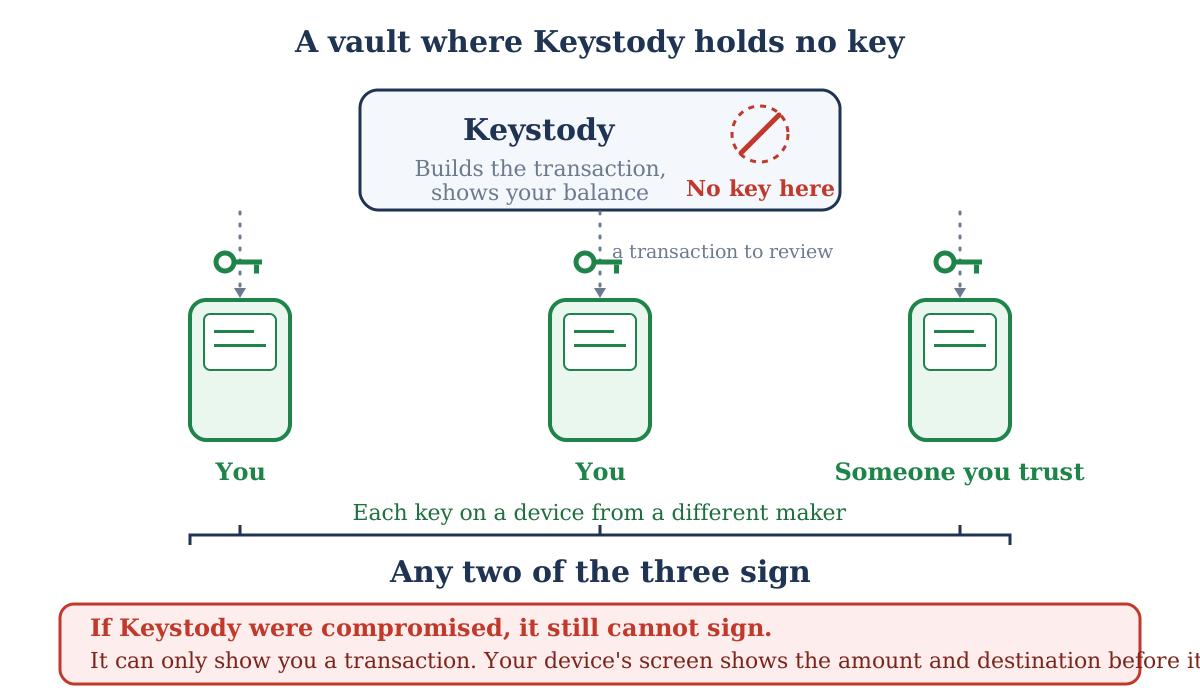
A Keystody vault is 2-of-3 multisig: three keys, any two of which can move funds. Every part of it answers the question this breach raises: who signs?
- No key of ours, anywhere. No production vault has ever had a Keystody-held key. With no key of ours in the vault, the threshold is out of our reach. If Keystody's servers were broken into, there would be nothing on them that can produce a signature.
- A different maker for every key. Every vault we set up puts each key on a hardware wallet from a different maker, so that a flaw in one manufacturer's device cannot reach two of your keys.
- The device screen has the last word. The amount and destination appear on your device's own screen before it signs. That is the step a compromised coordinator, Keystody included, cannot get past without you seeing it. A wrong receive address is caught by checking it on the device itself, which Keystody supports on Ledger and Trezor.
- Built for generations, not just day one. Setting up is the easy part; a vault has to keep working for decades, and for the people who come after you. Each vault gets a readiness grade from A to F. Keys get scheduled check-ups on the device itself, so a dead device shows up in a reminder rather than in an emergency. Recovery drills are recorded against the vault, and you get a recovery kit for the people who would need it, so your family or partners could use it without you.
- Open standards, no lock-in. The vault is described in standard output descriptors, so you can recover it with Sparrow or Bitcoin Core without Keystody being involved at all.
Want to see what this looks like for your own Bitcoin? Book a free 15-minute call and we'll talk it through.
For the full account, the primary sources and the trade-offs, read the in-depth piece: What the Binance Hack Says About Who Signs Your Bitcoin.